“I won’t be a doctor, but one day you will be sick.”
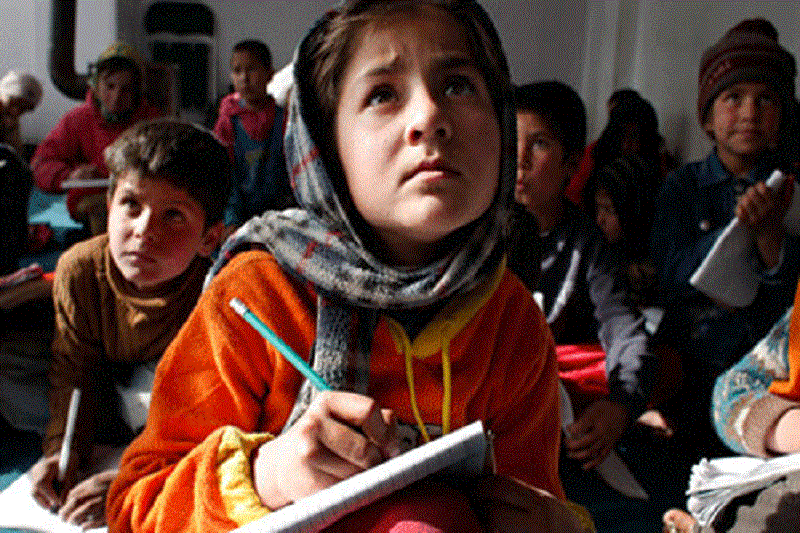
What does it take to destroy a country?
I want you to ask yourselves one question: “What does it take to destroy a country?”. Some will say violence, some will say corruption, some will say outside enemies, but the main factor of destroying a country is not educating the new generation and not giving them the basic opportunities to get educated.
This is the main problem in Afghanistan. When the Taliban had a hold of the country, they would only allows boys to get educated and it was mainly religious-based. But after the Taliban left, the government promised that the governmental and outside donations will go mainly to building schools around the country and would help ALL children get educated. But that is not the truth.
We cannot really know the number of girls that are or are not currently in school, because the government keeps changing the numbers each year and experts have come to a conclusion that even the government itself isn’t quite sure. But it’s estimated that over 2/3 of Afghan girls do not go to school.
What is keeping girls from going to school?
Well, there isn’t just one culprit that we can point our fingers to. There are many. These culprits combined, are guilty for a lot of ambitious and smart women not being in school where they belong.
A big problem is the patriarchal society. For years and years women have been viewed as not good enough, powerless, useless, ignorant, incompetent, so when these girls want to go to school, it is viewed as an outrageous thing. Fathers, brothers or even husbands forbid their female relatives or wives from pursuing an education because they view at as a waste of time, or they just don’t feel like it. Some girls’ relatives do not care what they do because they view them as not important enough for their attention, but these girls are in a constant fear that they will soon get married or their male relatives won’t view it appropriate that they go to school anymore. They wake up scared every morning that the day to come will be their last day of pursuing an education.
But there are also environmental problems that girls in Afghanistan face. Afghanistan is a very big country with a lot of land, big cities and small villages. Since there is so much space, and school isn’t viewed as important, a lot of girls don’t have a school close to their house and the weather conditions do not help them. To some girls, the closest school is 13 miles away, since the population is poor and there isn’t a valid transport system, girls don’t have any other choice, so they don’t go to school.
What about the small number of girls that do go to school?
Even though some girls may be allowed to go to school a lot of them face big challenges every day. Even though their fathers may allow them to go to school , the society isn’t as supportive, especially in small rural places. Male relatives may try hard to convince the father of the girl that her education isn’t important, and unfortunately in most cases, fathers listen.
But schools in Afghanistan are not the schools we know and attend in the Western World. A big number of Afghan schools don’t have ceilings and walls. They are set up in tents, and the teachers do the best they can. There aren’t enough books, teachers, basically the basic conditions needed for an education.
But not all teachers try. In many schools, women teachers aren’t allowed, but the male teachers do not accept to teach girls, and do not even bother to teach them when they are in their classes.
Child marriages
Another big factor in girls not going to school, is because they get married in very young ages, sometimes as young as 12. After they get married, their husbands don’t want their wives going to school getting an education, they want their wives home, doing housework and raising children.
Most girls in Afghanistan don’t have a say when it comes to their own marriage. They often get married young because in most cases their fathers view them as burdens that they need to get rid of. Their husbands don’t want them going to school, so there is no hope for the smart young girls for a bright future.
It is a problem that issues girls in Afghanistan, but it also issues girls around the world and our society in general. Because if one girl, one child, is being denied of their right of an education, then we are lost as a society.
Websites where I found the information :https://www.hrw.org/news/2017/10/17/afghanistan-girls-struggle-education
 I am Malala